Category Archives: fantasy

The Walk of Shame

Liz eased onto her feet. The sheet, which had wound its way around her foot sometime during the long night’s thrashings, trailed her like a train. She shook it off with impatience, more mindful of her body’s nagging soreness than the ridiculous irony of the image.

He had left before she had awoken. The room was a shambles, his belongings scattered across the floor as if abandoned in hasty disgust. In the bright morning sunshine the electric surge that had filled Liz’s heart at the apex of their encounter seemed all but drained away. She felt small, weak and exposed.

“Oh. You’ve awakened.” Frank stood there, hair mussed, clothes disheveled. He avoided her eyes as he gestured to the far corner. “Your dress is over there.”

“Thank you,” was all she could manage. Liz picked up the soft black garment, puddled it on the floor at her feet and then stepped in, aware of the odd pull of tightened muscles across her back. She struggled with the sleeves for a few moments, wondering if he was watching, wondering if he was aware of the toll their riotous night had taken on her. If he knew he made no attempt to assist her as she fumbled with the buttons. After a few moments of struggling she abandoned the top two, leaving a gaping V at the top of her shoulders, followed by a series of odd bulges and gaps where she had incorrectly fastened the fabric. She turned back to Frank and forced a small smile. “Better?”

Frank’s eyes, hooded with guilt, shifted to the door. “I have work.”

Liz started to nod, but then shook her head. “No.”

“Excuse me?”

“I will not.” She stamped her foot. An aching throb traced up her leg. Was there anywhere on her body their transgressions had not touched? Liz caught the warning arch of his eyebrow, the downward tug of his mouth and altered her tone. “How can you act this way? After last night–?”

“I am busy, that’s all. I told you, I have work to do.”

“And you don’t have time enough to spare me a moment now that your conquest is complete? Have you checked me off of your list, yet?” He didn’t answer and Liz choked back the lump in her throat. “How can you be this way?”

“I am not being any way,” Frank said. He ran his hand through his hair, tousling it even further. “I do not have time for this.”

“And I have no inclination to allow you to leave without admitting last night was special. You… My body… Touched everywhere. Your hands traced the most intimate parts of me. Last night we connected as no others have. Admit that, and I will leave you alone.”

“Of course!” Frank shouted. “Of course it was intimate. I was there! I was! But it is no longer last night. It is tomorrow.”

“I see.” Liz fought the tears that threatened to overspill. “It is tomorrow, and you have work to do.”

“Marvelous; you’ve got it. That is only what I have been telling you for the past five minutes.”

“Then do not let me keep you one second longer.”

He slid from the room like a scolded child, his shamed relief staining the air. Liz limped past the gurney to the window. The leaded panes mimicked the tracery of stitches across her face, the fine, careful lines Frank had sewn all over her body. He had made her. From castaway corpses to single being, he had made her, infused her with this life, and then cast her aside. She pressed her forehead against the glass until it hurt, staring out at a world she would never enter, straining away from the world she would never leave.

“You’re a bastard, Frank,” she whispered. “You’re a bastard.”


Lightening Up


A week ago I was at a nearby antique store. It’s a pretty cool place, located inside a monstrous old factory. The rows of antiques flow from massive room to massive room, the walls dematerializing from sheetrock to exposed brick as the spaces become less “done” and truer to their history. The aisles loop around, taking shoppers back from the final, huge warehouse space and back into human-scaled territory. I followed the u-turn of rows–like a rainbow slumped on its side–to a veritable pot of gold. Around the corner I found waiting for me a used book section consisting with numbers of science fiction and fantasy rivaling that of any new book store. And these weren’t just some grandad’s old, beat-up collection of seventies serial sci-fi (although that category was represented), there were tons of modern authors like Gaiman, Williams, Salvatore, Hamilton, Harris and Reynolds. Every category from steampunk to high fantasy had a representative in attendance. I ended up grabbing an armful of two-dollar bargains, seizing the opportunity to both expand my bookshelves and explore some new-to-me urban fantasy. I also picked up a Philip K. Dick complete collection (I’ve been dying to read the real Minority Report), and a handful of random, easy-on-the-brain fantasy titles, including a new Redwall book from Brian Jacques (I have a thing for mice and squirrels with swords).

In all, the selection I chose was fluffier than the usual–nice, short, fun books. And that made me start thinking about the term “Summer Reading” and why we feel compelled to lighten our mental load during the hot months. Does it have something to do with our old schooltime habits? Tossing our proverbial pencils in the air as the last bell rings and turning to more leisurely pursuits? Or is it embedded in our need to shed the heavy weight of winter? As our parkas, boots and sweaters are peeled off, as our diets become leafier and infused with flavors of citrus, do we continue to jettison of all things bulky and cumbersome? As soon as March has a firm hold on us, the tables at the bookstores entitled “Beach Reads” come creeping into the center aisles. I don’t go anywhere near the beach during the summer (despite the fact I live a mere twenty minutes away–it has something to do with heat, sharks and sand sticking to my sunscreen like Shake-n-Bake), but I nevertheless gravitate towards this pile of printed matter like a bird towards the equator. I like to think it’s my inner Peter Pan calling the shots, the little girl who used to sit on the lush grass and read under the shade of a giant tulip poplar insisting I take some time to run through the sprinkler just for the heck of it. It’s hard to deny her that urge; the pure, uncomplicated enjoyment of the shade, a nice swing, and a good book is hard to match.

Summer inspires much in all of us: a compulsion to try our hands at gardening, a yearning to put match to charcoal–and if you’re from the Eastern Shore a desire to sit at a table covered in newspaper and pound the shit out of crabs while eating corn and guzzling beer. But, most of all, I think summer reminds us to find the fun in life, if only one chapter at a time.


Mixing Fantasy and Reality

When I was little, I hated those squat, rainbow-hued My Little Pony toys. I was a huge fan of horses (yeah, what twelve-year-old girl isn’t?) and I had a collection of sixty-odd Breyer horses. You know those horses–prancing Morgans, preening Tennessee Walkers and galloping Arabians, each perfectly detailed and accurate down to the grooves in its hooves. I used to play with them by the hour, using Barbie as an accessory. In most little girls’ worlds Barbie was the main character and the horses would have been pets. But not me. Barbs was second-string, there to advance the plot, if at all. Most of the time my horses had human-free adventures. My pretend Mustang herd galloped across the open plain (the green shag carpeting of my bedroom floor), made friendships, were hunted, trapped and escaped back to freedom. And there was no place in that scenario for short-legged pink ponies with purple hair and stars on their asses. As much as I enjoyed fantasy, it had no place among my “reality.”

And yet that kid eventually grew up into the chick who digs blending modern life with the fantastical. I’m not sure how or when it happened. Maybe it had something to do with overdosing on too many sword and sorcery tales. Quite possibly Joss Whedon had a significant hand in the deal. Then again, maybe it was growing up to discover the enticing mysteries of adulthood were nothing more than chains which would tether me to a daily reality that was far less than mythic. In the midst of work, finances, housecleaning and insipid routines, I think I realized everyday life lacked the mystical quality my childhood held. Toadstools were only a sign of a fungus in my lawn, rainbows meant that it had finally stopped raining, and lightening bugs were just insects trying to get their freak on. And that loss of the “what-if” portion of my imagination must have had an impact, because somewhere in my mid-twenties I ditched the mainstream novels I had been planning and went genre.

While the mundane details of my daily life still exist on a grand scale, I now have an alter-existence where the strange, wondrous and mystical happens in the modern world. It’s like gaining back a lost bit of my childhood, a forgotten piece of me.

My horse collection is in my niece’s possession, now. But, I can still see every one of my old friends in my mind. And the next time I let the herd roam free, you can bet there’ll be some pink, yellow, and blue rumps mixed in with the rest.


The Extent of Responsibility

I was inspired to write this post after reading an article in Canada’s Globeandmail.com. The author, Lynn Crosbie gives a sometimes compelling argument about the relationship between art and life, and the way the two often bleed together in the form of mimicry. Drawing parallels to the rash of teens burning homeless men in the seventies after seeing it done in the movie Fuzz, and the copycat killings ascribed to the movie, Natural Born Killers, I can almost see Lynn’s point. The rest of the examples, however–Marilyn Manson’s “responsibility” for children’s crimes and Ted Bundy’s supposed addiction to porn linking him to his first rape–fail to move me to emphatic agreement. Still, I’m willing to concede there is a correlation between art and life, and sometimes it’s a negative one. After all, as artists, we want our work to resonate within the mind of the ones reading it. And, we’re more than happy to take the credit when that shift in thought is positive. Yet, when the negative occurs, we put our hands behind our backs and take refuge behind the word, “art.”

But, is it all that simple? Monkey see, monkey do? I don’t think so. If that were the case, there would have been social upheaval of the worst order after the debut of Pulp Fiction: heroin overdoses everywhere, gangster-type violence and thuggish dinner knock-overs on every block. Most of us know the difference between reality and fiction, the immediate relationship between action and consequence, and we act accordingly. For some, however, the lines are blurred. Fantasy becomes reality and the intended thought-provoking words we put on paper transform into inspirational text. Since I can’t argue that some will take away only the evil of which we write, I move on to the next concern, responsibility. Can we, as artists, be blamed for the actions of those who use our work as an instruction manual?

The waters here are murky and gray. I’d like nothing more than to shrug the weight of it off my shoulders and hide behind the art. My novel speaks of darkness, of acts unspeakable in reality and just as horrifying to the imagination. It has bothered me more than once that one might see these pages as a permission slip, a validation of their own flawed belief system. These acts are integral to the story, to the formation of the characters and the relationships they have with one another. But, I cannot argue that someone with an already skewed perception of the world might not see that, will only see rote approval for their twisted lifestyle. Having conceded that point, can I remove all blame from myself if someone takes inspiration from my words? Can I, with all honesty, step away from this mirrored act without a speck of guilt on my soul? I’d like to, but, I don’t know. Once a connection has been established, cause and consequence, can there really be absolute blamelessness? Sure, the individual could have picked up “pointers” from any other book or movie, hell, the internet is a literal den of inequity. But, the source was not from them, but from me. My work. Like the rest of life, there is no black and white, here. But, there is right and wrong as far as fallout is concerned, and most certainly when the time for finger pointing comes around. The question is not if any fingers will be aimed in my direction, because they will. More importantly, I wonder, where will my own be pointing?


Being Not


I thought I was done writing Not chapters. But, during my editing today, I decided she needed one last hurrah. I haven’t really talked about her, or any of my characters, really (aside from Resonance’s/Spider’s blog on MySpace). She’s a prisoner of a dark magickian named Arhreton who has used her since infancy to complete monthly rituals that will bring him the power of the legendary warrior, the Middu. He tortures and torments her not only for his magickal gain, but also because the Middu is everything, and she is — Not.

Not can’t speak, has no capacity for real human interaction and is a victim in every sense of the word. Her only saving grace is the ability to bi-locate — to transport her consciousness to another body in ancient Sumer, where Eight gods once ruled over humans. The interactions between the warring deities are viewed through her skewed perspective.

Despite the disturbing research I had to do on feral children (the photo above is of Victor, the wild boy of Aveyron), and the horrific conditions of her upbringing, she surprised me by being a fun character to write. With my other characters — even Resonance (sorry, Res) — I’m easily distracted. I get irritated because the words don’t readily flow like they do with her. I wander to the refrigerator, which is perilously close to my desk. I wander back and peck out a few more words. But with Not, I get lost. She’s tragic, funny, and sometimes fairly evil. Her thought processes waver between insightful and hopelessly jumbled. I always have to be on my toes when she’s around, because she’ll take me off on some wayward journey and once it starts, all I can do is go along, just to see where she leads me.

Not was never intended to be a point-of-view character. I thought I had enough going on with three POV’s. Then I realized if I wanted to explain the gods’ back-story without the main characters having to read about them from dusty texts, I’d have to have someone experiencing their past along with them. So Not became a major player and the story of the gods was sprinkled throughout the book with more lively (if somewhat muddled) interpretation of events provided by her.

The majority of the book had been written when I made this executive decision. I worried that it was the wrong choice, that I’d be spoiling an otherwise good book. Luckily for me it turned out not (small pun intended) to be the case. I feel she’s given this story a depth it previously lacked, and I hope that readers can, if not actually like her, find her interesting. If it isn’t too pretentious to say — I do.


Flash Fiction


The Hell of Dying
Agony twitched Julia’s limbs in time to the rhythm the fire beat out inside her body. 
Life.  Death.  Life.  Death.  Life.  Death.
The Pilferers fretted their lancinating fingers so the needles sang like chimes, adding their restless anticipation to the tune searing through her.  Soon, they would have one more body to toss onto the putrefying mass at her side.  So many in that pile had once been her anchors to life.  Their absence burned her mind to pitch.
Julia pushed to her knees, screaming with the effort.  The Pilferers stabbed their fingers into the pulses of their throats and extracted more bilious blood.  Amber beads hissed from the tips.
The Hell of dying.  That was what the Pilferers delivered—the fear of the unknown, the grief of parting.  Their liquid dread incapacitated the most gifted Magi, turned their power to fire in their veins, rolled it through their wasted flesh to puddle on the dirt where the parasitic demons lapped it up like dogs.
Julia’s lips split in a mirthless grimace.  Everything she would have regretted lay piled in that stinking corner.  No loose ends.  No fears.  The needles plunged into her arms once again.  This time, her mounting power met the invasive liquid, and drove it back into the Pilferers’ hands. 
The cave overflowed with agonized screams as the Pilferers fought to banish the dull apathy she had gifted them.  They writhed on the floor, incapacitated and denied their crucial sustenance. 
They couldn’t hurt her, not now.  There was nothing left to do but see how well she could make them match the remains of her family and friends.
Julia retrieved her sawed-off shotgun, and went to work.


******


You Want to Know About Heroes?


I can shatter bone. With no more effort than it takes you to grab a pencil, I can pulverize your femur. With a flex of my quads I can leap to the top of your house, and with a swipe of my arm, I can topple it. As a child you gazed with longing at candy-colored comic books, wishing to be all that I already am.


They cry. All night. Voices in the dark, shouting, screaming, pleading. They scurry across the earth, unable or unwilling to pry themselves from the role of victim. “It’s too hard,” they say. “It’s too hard. Help me.”


I did, at first. To shut them up, to win myself a decent night’s sleep. I saved the first one. A sweet-bodied guy with shining chestnut hair and eyes to match. As I convinced his assailants they had chosen the wrong victim, he took in the carnage I wrought with those dark, wide eyes. After the electric terror faded, after the sting of being rescued by a chick had eased from them, I found those eyes were the same as the rest of him–sweet and grateful. I let him thank me. All night. He eventually dozed off, but the screams kept coming. I stared into the blackness and wished for them to stop. The sirens echoed their wails–one passing so near it started my boy out of his exhaustion. He rolled onto his side, blinked those stupid doe eyes at me and said, “Aren’t you going to help them?”


I got up fast, was out of there before the shape of my head had smoothed from the pillow. I left him lounging in bed, confident that now he was safe, his hero was going out to save the rest of the world.


I went and got a drink.


Then another.


Then another.


Behind me, some bastard at the pool table smacked his girlfriend in the face for sloshing his beer. I let him.


There were other times I felt more generous. Times when a rapist was found mangled and stuffed in a trash can. Times when a serial killer stopped killing and the cops thought they’d somehow lucked out and managed to jail him on unrelated charges. But for each of those times there were scores where I heard, and did nothing. Times when I just didn’t feel like getting involved.


I can still hear them. Despite the four window air conditioners I have running at full-tilt, despite the music I play so loud it throbs my eardrums and gives me vertigo, I can still hear them screaming for me. I turn up the volume, and pray for sleep.


So, what do you think of me now, kids? Do I fit inside your hard-lined squares of colorful ink? Do my words fill in the bubbles?


Am I your hero, or what?

*******
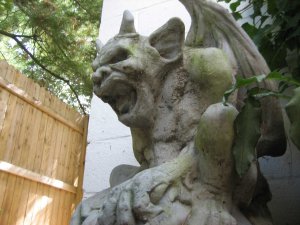

The Empress of the Fescue


This is how a snake feels, awaiting the first rays of light to banish the insidious chill. This is how it will always feel, cold and alone. This is why my desperation grows–as hers must have-wild.

I purchased her at an estate sale to stand sentry against the hordes of sticky-mouthed candy-grabbers trampling my front lawn. My beautiful, winged, snarling chimera, the Empress of the Fescue.

With a childish thrill I ventured under the harvest moon to admire her fearsome grimace. Only a flattened patch of turf remained to belie her post. There was no time to gape, or wonder. She came with full fury, a winged wrecking ball to the back. I toppled forward against the dew-dampened grass, gasping for air.

Masonry talons clicked against the sidewalk. I heaved onto my back. She was there under the halo of light, waiting for my gaze to register her carven jaws stretched wide with hunger. Panic jolted my bones and I scrabbled away, clawed hands and bare feet churning the earth in desperation.

The grass was slick. I was slow.

Her terrible weight prematurely expelled the last of my breaths. That gaping mouth sucked deep into my own. I struggled to stay inside, but there was nothing to hold onto, no anchor to cast.

I pushed myself up with shaking arms.

Not me.

She, wearing me.

I fit her like a well-made suit, and she smiled. She did a small dance of joy, cavorting out of view as she tried her new legs. My head could not turn to follow. Cast in a haze of gray, my world contracted to a narrow strip of grass, a patch of siding, and my living room window.

It aches, sitting here with my knees hunched around my chin. A spider has built a web in the crevice of my right ear. The grass is cold against my immovable hide and I spend the long dark wishing for the following day to come without rain or clouds so I might briefly remember warmth.

I catch snippets of her through the window, clips from a movie I will never see. She seems happy. And why shouldn’t she be? She has it all: my life, my husband, my flesh. And she has me, her Empress of the Fescue.


********


Problem Child

The creature stopped twitching, and immediately she wished she could take it back. She held her daddy’s hammer tightly in the palm of her shaking hand and stared at the mess that had not too long before been a head. The insides of her stomach twisted into a dozen tight balls of string. There was no taking this back. No putting life back into the small form.

She gazed at the ruined body in contemplation. It had been so small, so weak. When she had picked it up, the thing squawked and squealed in panic, but had been helpless to do anything more. Surely that meant something? Her young mind gnawed the problem, chewing it like tough meat. She gazed at the lifeless shell, and the bits of swirling emotions settled, locking in her mind as a much more logical, concrete outlook.

Because it had no chance against her, the creature deserved to fall under her control. With no means to defend its life, its death became hers to decide. She hefted her daddy’s hammer in her hand and felt a surging swell of dominance. The young monster gazed down at the rest of the tiny, scurrying humans, and smiled.


********

The Love of the Job

Like a mechanical mosquito the needle hammered into his flesh, drawing out slick smears of crimson, depositing various shades of gray in return.

Remember Nikky, this spot is mine.

Those had been the last words spoken to him by his grandfather, Sid “the Ink” Shepherd, as the dying old man patted the final bit of virgin skin on Nick’s motley arm. Now only the walls’ collection of flash stood as silent witness to the fulfillment of that promise, the memorialization of Nick’s mentor, despite the torturous regret it fostered.

The job was going horribly wrong.

Nick’s sweat-slicked right hand clung to the battered, duct taped armrest as his defiant left arm steadily worked his grandfather’s prized shader across his flesh. He could no more stop its progress than will the frenzied staccato of his heart to slow. The needle buzzed into his skin with hot, jabbing intensity. The newly injected ink swarmed through the dermis, breaking lines here, joining others there, willfully reshaping his chosen design to suit its own undisclosed end. Nick could do nothing but watch.

After hours of slow agony, the maniacal tension in Nick’s arm dispelled and the shader clattered to the floor. His stomach knotted with trepidation, Nick grabbed a handful of rough paper towels and wiped away the sanguine and ebony swirls. From its place in the center of his forearm, the grayscale visage of his grandfather stared sternly up at the collection of lewd cartoons pinned to the ceiling. Like a slow moving wave, the skin on Nick’s arm gathered and broke, folding over his grandfather’s eyes as dark, hooded lids. The tattoo gave a slow blink and then rolled its gaze down, sweeping back and forth, studying its new incarnation. Sweat ticked down Nick’s face as the eyes–those eyes wrought by his own hand–turned upwards to bore into him. With a careful stretch of its mouth, the tattoo gave Nick an admonitory scowl.

“Your shading is shit, boy.”


***********


The Walk of Shame

Liz eased onto her feet. The coverlet, which had wound its way around her foot sometime during the long night’s thrashings, trailed her like a train. She shook it off with impatience, more mindful of her body’s nagging soreness than the ridiculous irony of the image. 

He had left before she had awoken. The room was a shambles, his belongings scattered across the floor as if abandoned in hasty disgust. In the bright morning sunshine the electric surge that had filled Liz’s heart at the apex of their encounter seemed all but drained away. She felt small, weak and exposed.

“Oh. You’ve awakened.” Victor stood just inside the doorway, hair mussed, clothes disheveled. He avoided her eyes as he gestured to the far corner. “Your dress is over there.”

“Thank you,” was all she could manage. Liz picked up the soft black garment, puddled it on the floor at her feet and then stepped in, aware of the odd pull of tightened muscles across her back. She struggled with the sleeves for a few moments, wondering if he was watching, wondering if he was aware of the toll their riotous night had taken on her. If he knew, he made no attempt to assist her as she fumbled with the buttons. After a few moments of struggling she abandoned the top two, leaving a gaping V at the crest of her shoulders, followed by a series of odd bulges and gaps where she had incorrectly fastened the fabric. She turned back to Victor and forced a small smile. “Better?”

Victor’s eyes, hooded with guilt, shifted to the door. “I have work.”

Liz started to nod, but then shook her head. “No.”

“Excuse me?”

“I will not.” She stamped her foot. An aching throb traced up her leg. Was there anywhere on her body their transgressions had not touched? Liz caught the warning arch of his eyebrow, the downward tug of his mouth and altered her tone. “How can you act this way? After last night–?”

“I am busy, that’s all. I told you, I have work to do.”

“And you don’t have time enough to spare me a moment now that your conquest is complete? Have you checked me off of your list, yet?” He didn’t answer and Liz choked back the lump in her throat. “How can you be this way?”

“I am not being any way,” Victor said. He ran his hand through his hair, tousling it even further. “I do not have time for this.”

“And I have no inclination to let you leave without admitting last night was special. You… My body… Touched everywhere. Your hands traced the most intimate parts of me. Last night we connected as no others have. Admit that, and I will leave you alone.”

“Of course!” Victor shouted. “Of course it was intimate. I was there! I was! But it’s no longer last night. It is tomorrow.”

“I see.” Liz fought the tears that threatened to overspill. “It is tomorrow, and you have work to do.”

“Marvelous!  You’ve got it. That’s only what I have been telling you for the past five minutes.”

“Then do not let me keep you one second longer.”

He slid from the room like a scolded child, his shamed relief staining the air. Liz limped past the gurney to the window. The leaded panes mimicked the tracery of stitches across her face–the fine, careful lines Victor had sewn all over her body. He had made her. From castoff corpses to single being, he had made her, infused her with this life, and then tossed her aside. She pressed her forehead against the glass until it hurt, staring out at a world she would never enter, straining away from the world she would never leave. 

“You are a bastard, Victor,” she whispered. “Such a bastard.”